
Chicken manure is a valuable agricultural resource in today’s world of large-scale poultry farming. It is full of nitrogen, phosphorus, and organic matter. But if not handled correctly, it can cause a lot of ammonia pollution, contaminate groundwater, and spread pathogens. As a result, modern farms have to find a way to balance following environmental rules with using resources.
More and more evidence shows that chicken manure composting machines are important for safely, stably, and sustainably using chicken manure. The quality of fermentation depends on more than just the raw material. It also depends on whether the fermentation system can keep an aerobic environment at a high temperature all the time.
Chicken manure usually has 3-5% nitrogen and a lot of organic matter and minerals. But putting it directly on fields is very risky:
Chicken manure composting machine uses high-temperature aerobic fermentation technology to get rid of harmful parts and speed up the breakdown of organic matter. This process makes stable humus, which cuts down on pollution in the environment by a lot.
Research shows that fermentation temperatures can quickly rise above 60°C when there are ideal aerobic conditions. This high-temperature phase effectively kills pathogens and parasite eggs while speeding up the breakdown of antibiotic residues.
For large-scale farms, the fermentation completion of chicken manure composting machines should not be judged by experience alone but measured through quantifiable indicators.
The C/N ratio of mature organic fertilizer is usually between 10 and 15. A ratio that is too high means that the material has not fully broken down, while a ratio that is too low could cause nitrogen to escape. Stabilization around 10 means that the material has completely broken down, so there is no chance of secondary fermentation.
During high-temperature aerobic fermentation, the amount of ammonium nitrogen goes down and the amount of organically bound nitrogen goes up. This shows that nitrogen is being fixed in humus structures. This keeps nitrogen from getting away and makes the fertilizer work better over time.
Ammonia is often released during early fermentation, which makes the pH level alkaline. When the decomposition process is done, the pH levels off in the best range for plants to take in, which is between 6.5 and 7.5.
Proper dehydration makes it easier to store and move things while lowering the risk of mold growth.
Only when all these indicators are met simultaneously does chicken manure qualify as commercial organic fertiliser. Chicken manure composting machines effectively ensure these standards are met.
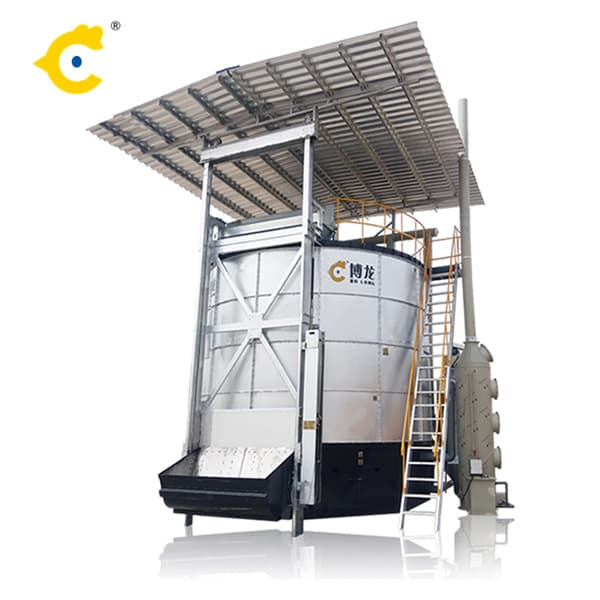
Addressing large-scale farming demands, Bolong’s chicken manure composting machine employs a sealed vertical structure to achieve a truly controllable industrial fermentation environment.
The tank features thermal break insulation to minimize heat loss, enabling effective accumulation of microbial-generated heat. This ensures stable operation even in low-temperature environments.
An intelligent control system precisely regulates oxygen supply, maintaining continuous aerobic conditions within the material to prevent anaerobic putrefaction and odor generation.
Latent heat from exhaust gases is recovered via a heat exchange system for reuse, creating a thermal internal circulation loop. This reduces external energy consumption requirements, enabling low-carbon operation.
The PLC system keeps an eye on temperature, humidity, and oxygen levels all the time. It changes the operating modes automatically based on these factors to make sure that fermentation stays stable and controllable throughout the whole process.
Large-scale chicken manure composting machines not only speed up the fermentation process, but they also make the end product much safer and more consistent than traditional composting methods.
The high-temperature environment functions not only as a sterilization method but also as a “selection process.” Functional microbial communities, such as thermotolerant Bacillus species, become more common when temperatures stay high for a long time. These microorganisms help plants grow better by making their roots stronger, using nutrients better, and making them more resistant to disease.
Field trials show that using mature, high-temperature aerobically fermented chicken manure as base fertilizer greatly boosts the yields of both cash crops and vegetables. This means that chicken manure not only gets rid of harmful things, but it also becomes an important part of making crops grow.
The resource potential of chicken manure does not originate from the raw material itself, but from scientifically developed, stable high-temperature aerobic fermentation technology. Sustained high temperatures, effective sterilization, stable nitrogen conversion, and the enrichment of functional microbial communities can only be achieved in controlled industrial settings.
The closed design, smart control system, and heat recovery technology are what make Bolong’s chicken manure composting machine work. It offers manure treatment solutions for big farms that can be copied and expanded. It is more than just equipment; it is a whole system for recycling resources.
Get in touch with us today if you need a chicken manure composting machine or an organic fertilizer production line.